How the Curse of Ham Theory Developed Historically
- May 7
- 8 min read
Updated: May 15
The “Curse of Ham” theory is one of the most influential distorted interpretations in Western history. It developed gradually over centuries and was eventually used to justify slavery, racial hierarchy, and colonialism — even though the biblical text itself does not teach racial inferiority.
What the Bible Actually Says
In Genesis 9, after the Flood, Noah becomes drunk. Ham sees his father’s nakedness and tells his brothers. Shem and Japheth respectfully cover Noah.
When Noah awakens, he says:
“Cursed be Canaan; a servant of servants shall he be unto his brethren.”— Genesis 9:25
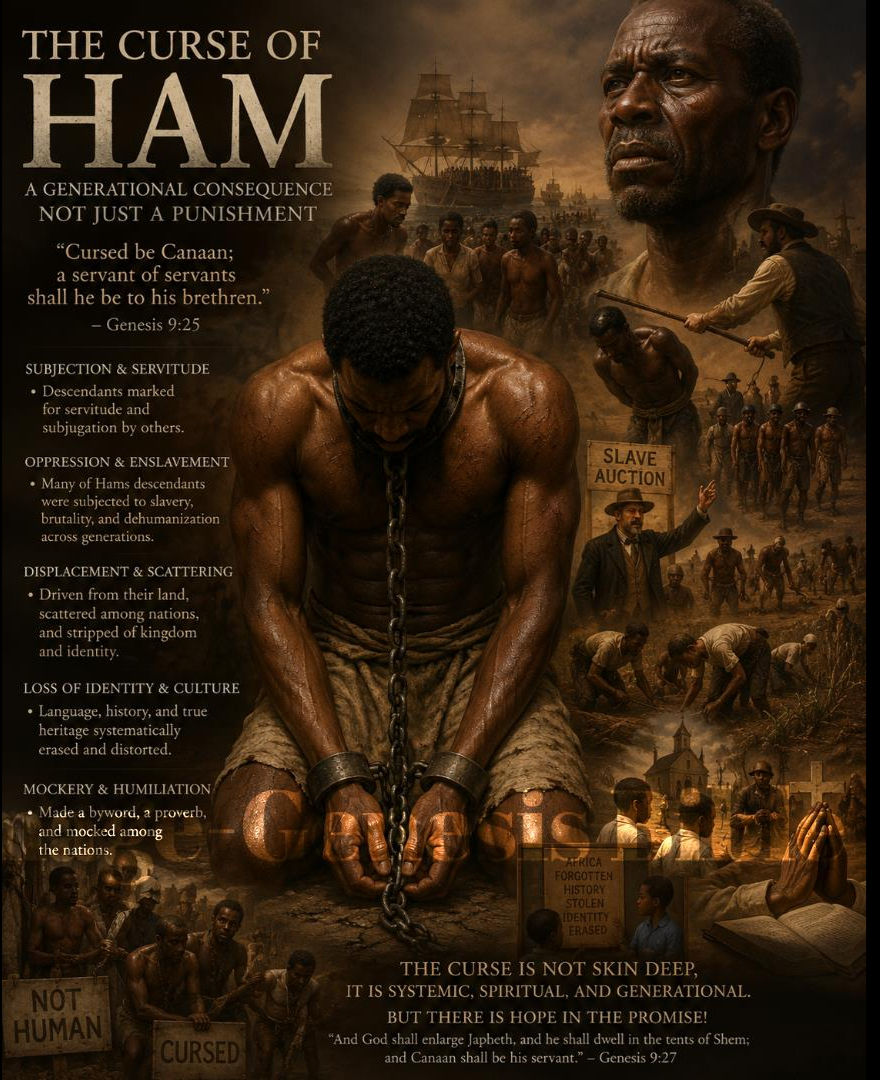
A deep look into how Genesis 9 was interpreted, misused, and politicized across centuries to justify slavery, racial hierarchy, and oppression — despite the biblical text specifically speaking of Canaan, not an entire race of people.
Important observations:
Noah cursed Canaan, not Ham
The passage never mentions black skin
It never mentions Africa
It never says an entire race is cursed
It never says slavery is approved by God
Canaan was one of Ham’s sons. Ham had other sons:
Cush
Mizraim
Put
Canaan
Many African regions in biblical geography were connected more with Cush than Canaan.
Early Ancient Interpretations
Early Jewish and Christian interpreters discussed:
Ham’s dishonor
family rebellion
prophetic judgment on Canaanite nations
But the earliest interpretations generally did NOT create a worldwide racial doctrine saying black people were cursed.
Some ancient writings speculated about punishments or servitude, but the fully developed racial system came much later.
The Shift During Slavery and Colonialism
The major transformation happened during:
the Atlantic slave trade
European colonial expansion
plantation slavery (1400s–1800s)
European powers needed a religious justification for enslaving Africans permanently.
So interpreters began combining several false assumptions:
Ham was the ancestor of Africans
The curse on Canaan applied to all Hamites
Servitude meant racial slavery
Africans were divinely destined to serve Europeans
This became known as the “Curse of Ham” doctrine.
How the Theory Was Expanded
Over time, writers added ideas not found in Scripture.
False Addition #1 — Black Skin as the Curse
Some later interpreters claimed Ham or his descendants were marked with dark skin.
But Genesis never says this.
The Bible actually contains many positive references to Cush/Ethiopia:
Moses married a Cushite woman
the Ethiopian eunuch receives the gospel
Cush appears in worship and prophecy
Ethiopia is portrayed as a powerful kingdom in Scripture
False Addition #2 — Africans Meant for Slavery
Slave traders and pro-slavery theologians claimed Africans were destined to be servants.
This interpretation became deeply embedded in:
slave-holding churches
colonial governments
European education systems
racial science theories
Some sermons openly taught:
Slavery fulfilled Noah’s prophecy.
Connection to Scientific Racism
By the 1700s–1800s, biblical distortion merged with pseudo-science.
Writers attempted to classify humanity into racial ladders:
Caucasian
Mongolian
Ethiopian
etc.
Then they linked Genesis 10 (the Table of Nations) to racial categories.
Europeans were often placed at the “top” while Africans were portrayed as permanently cursed or inferior.
This was not biblical exegesis.It was political ideology mixed with selective theology.
How Churches Responded
Not all Christians accepted this doctrine.
Many abolitionists rejected it completely.
Some argued:
the curse was only on Canaan
Christ breaks all curses
slavery contradicted the gospel
all nations are equal before God
Black churches, Ethiopian traditions, and many Eastern Christians often rejected Western racial readings.
Ethiopian and African Christian Perspective
Ancient Ethiopian Christianity predates much European colonial theology.
In Ethiopian traditions:
Cush was not viewed as cursed
African identity was not seen as spiritually inferior
Scripture emphasized covenant, righteousness, and divine image
The Ethiopian eunuch in Acts 8 is significant because:
he becomes one of the earliest Gentile converts
he is received without racial condemnation
the gospel reaches Africa very early
This stands in contrast to later European racial theology.
Modern Biblical Scholarship
Most modern scholars reject the racial interpretation because:
the text does not support it
the curse targets Canaan specifically
race categories are modern constructs
slavery theology distorted Scripture for economic gain
Today, many theologians view the “Curse of Ham” doctrine as:
a misuse of Scripture
a colonial invention
a theological justification for oppression
Deeper Spiritual Themes in Genesis 9
Many biblical interpreters instead focus on:
honor vs dishonor
covenant order after the Flood
prophetic consequences of sin
family corruption spreading through generations
the future conflict between Israel and Canaanite nations
The passage becomes about covenant history — not racial hierarchy.
Pro-slavery theologians claimed Africans were destined to be servants.
Several pro-slavery writers, ministers, and theologians from Europe and America used the so-called “Curse of Ham” interpretation to argue that Africans were divinely destined for servitude. These views were widely challenged even in their own time and are rejected by most biblical scholars and Christian traditions today because Genesis 9 curses Canaan — not Ham himself, and not all African peoples.
Some of the most influential figures and movements connected to these ideas include:

George Fitzhugh — defended slavery in books such as Sociology for the South and argued that slavery was a “natural” social order.
George Fitzhugh was not primarily known as a church leader or ordained theologian. He was mainly a Virginia lawyer, social theorist, and pro-slavery writer in the 1800s. Historical records do not clearly identify him as being formally tied to a specific denomination in the way ministers such as Baptist or Presbyterian clergy were. (Wikipedia)
However, he operated within the broader culture of the pro-slavery American South, where many defenders of slavery were connected to:
Southern Presbyterian churches
Southern Baptist churches
Episcopal/Anglican traditions in Virginia
Methodist groups in the South
Fitzhugh himself focused more on social and political theory than pastoral ministry. His writings borrowed biblical arguments used by Southern clergy, but he is generally remembered as a pro-slavery intellectual rather than an official church theologian. (Wikipedia)
Thornton Stringfellow — preached that slavery was biblically ordained and used Genesis 9 to defend enslaving Africans.

Thornton Stringfellow was affiliated with the Baptist tradition, specifically among Southern Baptists in Virginia during the 1800s. He served as a pastor in Virginia and became known for defending slavery through biblical arguments.
He wrote influential pro-slavery works such as:
A Brief Examination of Scripture Testimony on the Institution of Slavery (1841)
Stringfellow argued that slavery was permitted by Scripture and used passages from Genesis and the New Testament to support the institution of slavery in the American South. His writings became influential among pro-slavery Southern clergy before the Civil War.
Historically, many Southern Baptist leaders of that period supported slavery, which contributed to the formation of the Southern Baptist Convention in 1845 after divisions over slavery with Northern Baptists.
Modern Baptist groups today widely reject those pro-slavery interpretations as distortions of Scripture and contrary to Christian teaching on human dignity.
Josiah Priest — wrote Bible Defence of Slavery, promoting the idea that Black Africans descended from Ham and were cursed to servitude.


Josiah Priest does not appear to have been formally affiliated with one well-known denomination in the way ordained ministers like Thornton Stringfellow were. Historical sources describe him more as a writer, lay preacher, and religious polemicist than an official church theologian. (Wikipedia)
However, he was associated with:
Fundamentalist Protestant Christianity
Biblical literalism
Revivalist religious culture in 19th-century New York
Sources note that he was active among churchgoers and reportedly performed sermons, but there is no clear evidence identifying him as an ordained Baptist, Presbyterian, Methodist, or Episcopal minister. (Wikipedia)
His writings, especially:
Slavery, As It Relates to the Negro, or African Race (1843)
Bible Defence of Slavery (1851)
became influential among pro-slavery readers because he tried to use Genesis 9 and the “Curse of Ham” theory to justify slavery and racial hierarchy. Modern historians and biblical scholars widely classify his work as racist pseudohistory and a distortion of Scripture. (Wikipedia)
James Henley Thornwell — defended slavery in the American South and argued that Scripture permitted it.

James Henley Thornwell was affiliated with the Presbyterian church, specifically the Southern Presbyterian tradition in the United States during the 1800s.
He served as:
A Presbyterian minister
Seminary professor
President of the University of South Carolina for a period
Influential theologian in the Presbyterian Church in the Confederate States of America
Thornwell strongly defended slavery before the American Civil War and argued that slavery was permitted in Scripture. He became one of the leading theological voices of the Southern Presbyterian movement.
He was connected to:
Old School Presbyterianism
The Presbyterian Church in the Confederate States (formed during the Civil War)
Like several Southern theologians of his era, Thornwell argued that abolitionists were going beyond Scripture by condemning slavery outright. Modern Presbyterian denominations largely reject those teachings and acknowledge the misuse of biblical texts to support slavery and racial hierarchy.
Robert Lewis Dabney — supported slavery and later segregation using theological arguments.

Robert Lewis Dabney was affiliated with the Presbyterian church, specifically the Southern Presbyterian tradition in the 19th century United States.
He served as:
A Presbyterian minister
Seminary professor
Theologian in the Confederate South
Chaplain and chief of staff for Stonewall Jackson during the American Civil War
Dabney was connected to:
Old School Presbyterianism
The Presbyterian Church in the Confederate States of America
Later the Southern Presbyterian Church (PCUS)
He became known for:
Defending slavery before and after the Civil War
Supporting segregation after emancipation
Writing theological and social arguments against racial equality
Dabney believed slavery was biblically permitted and opposed Reconstruction-era racial reforms. His writings later influenced parts of Southern conservative theology.
Today, many Presbyterian historians and churches openly reject Dabney’s racial teachings and recognize them as part of the historical misuse of Scripture to defend slavery and white supremacy.
Many 18th–19th century Southern church leaders in parts of the United States used distorted readings of Genesis 9:25–27 to justify the transatlantic slave trade and plantation slavery.
Historically, the theory developed gradually:
Ancient Jewish and early Christian writings sometimes speculated about Ham’s descendants, but they did not create modern racial categories.
During the Arab slave trade and later the European transatlantic slave trade, some interpreters increasingly connected Ham with Africa.
By the 1700s–1800s, pro-slavery theologians merged the “Curse of Ham” idea with emerging racial theories and colonial ideology.
This interpretation was then used politically to justify enslavement, segregation, and racial hierarchy.
Modern biblical scholarship generally rejects this interpretation for several reasons:
The curse in Genesis 9 falls on Canaan, not Ham.
The Bible never links skin color to the curse.
“Servant of servants” was interpreted in an ancient tribal and political context, not a modern racial one.
The descendants of Ham in Genesis 10 include many nations, kingdoms, and civilizations such as Egypt (Mizraim), Cush, and Canaan.
Many African, Ethiopian, and non-Western Christian traditions strongly reject the racialized interpretation and emphasize the unity of humanity from Noah after the Flood, often connecting this to Acts 17:26:
“From one blood He made all nations of men.”
Many Southern church leaders in the United States during the 18th and 19th centuries defended slavery using biblical arguments, especially passages like Genesis 9 (“the Curse of Ham”), Ephesians 6:5, and Philemon.
Ephesians 6:5 Servants, be obedient to them that are your masters according to the flesh, with fear and trembling, in singleness of your heart, as unto Christ;
These leaders came from several denominations, especially Baptist, Presbyterian, Methodist, and Episcopal traditions in the South.
Some notable Southern church leaders associated with pro-slavery theology include:
Thornton Stringfellow — Baptist minister in Virginia who argued slavery was ordained in Scripture.
James Henley Thornwell — influential Southern Presbyterian theologian who defended slavery as biblically lawful.
Robert Lewis Dabney — Presbyterian minister and Confederate supporter who promoted slavery and segregation.
Richard Furman — early Southern Baptist leader who wrote defenses of slavery from the Bible.
Basil Manly Sr. — prominent Southern Baptist leader and slavery defender.
William Meade — Episcopal bishop from Virginia who supported slavery while encouraging humane treatment of enslaved people.
Benjamin Morgan Palmer — influential Presbyterian preacher in New Orleans who defended the Southern slave system.
Nathan Lord — though based in the North at Dartmouth, he defended slavery with biblical arguments and influenced Southern readers.
Joseph Ruggles Wilson — Southern Presbyterian pastor and father of President Woodrow Wilson who supported the Confederacy and slavery.
These leaders were connected to denominations such as:
Southern Baptist Convention
Southern Presbyterian churches
Methodist Episcopal Church, South
Episcopal dioceses in the Southern states
Historically, these churches split from Northern branches largely because of disagreements over slavery:
Southern Baptists separated in 1845.
Methodist churches split in 1844.
Presbyterians divided into Northern and Southern branches during the Civil War era.
Not all Southern Christians supported slavery, however. There were also:
abolitionist Christians,
free Black churches,
anti-slavery evangelicals,
and enslaved believers who rejected pro-slavery theology.
Today, many denominations have formally repented of or publicly rejected these earlier teachings:
The Southern Baptist Convention issued resolutions repudiating racism.
Presbyterian and Methodist bodies have acknowledged the misuse of Scripture in supporting slavery and segregation.


Comments